•
•
•
•
•
•
•
•
•
•
After the liberation of Auschwitz, an Italian prisoner of War begins a torturous voyage home to Turin, through a Europe caught between war and peace.

Primo Levi

Cesare
Greek

Unverdorben

Ferrari

D'Agata

Flora

Daniele

Egorov
Colonnello Rovi

Maresciallo

Galina

Mongol

Lieutenant

Carmine

Kapo
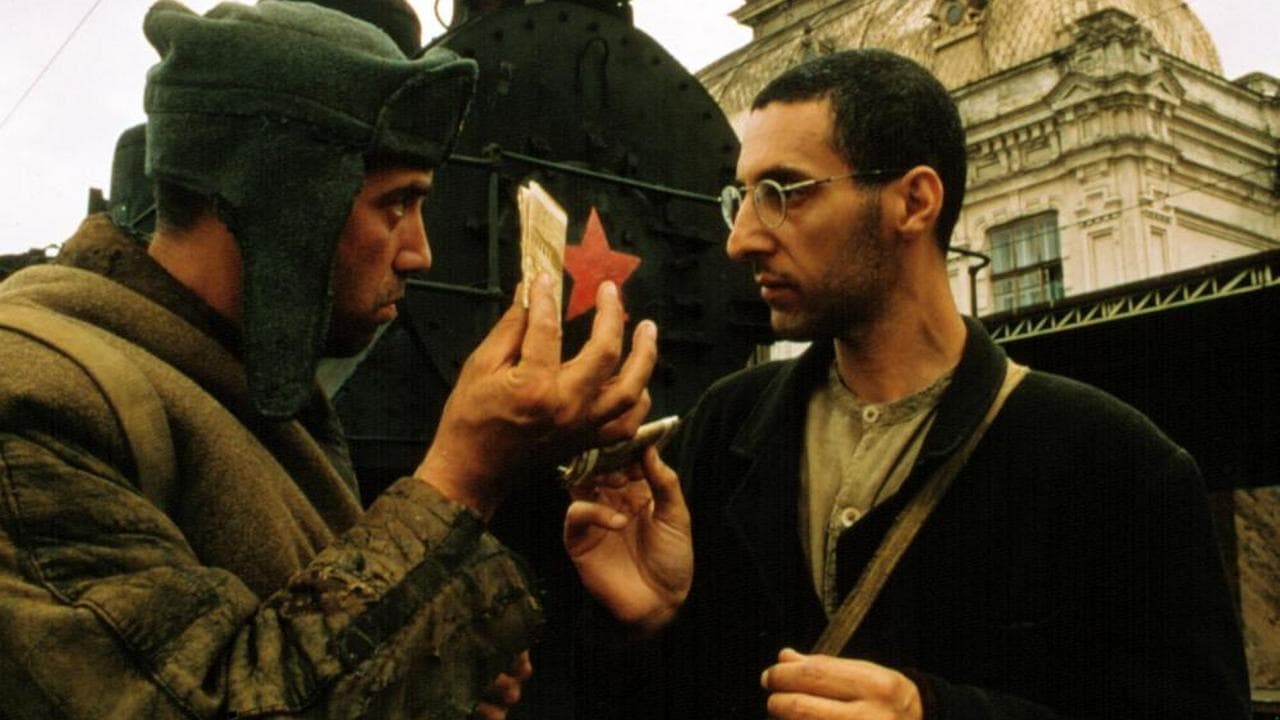
Based on real life events - or perhaps I should say near death events - this follows the fairly epic journey undertaken by Primo Levi (John Turturro) after the fall of the Nazis in 1945. He'd hitherto been imprisoned in Auschwitz but the Soviet arrival saw them all released, or abandoned really, and him determine to return home to Turin. Though he is now free, he is left to his own devices and discovers quite rapidly that what law and order there ever was has now been subsumed into an agenda of survival of the sharpest - and his journey isn't going to prove straightforward. He reckons that a train will be his best option but instead of taking him towards Italy it ends upon taking him further into Poland's interior and to adventures that see him encounter the affable and wily "Greek" (Rade Serbedzija) before staying in a camp for refugees and then finally reuniting with some like-minded folks in the hope that he can finally get back to what he calls home. There's a graphic map at the very end that shows us just how convoluted his journey was, but it also serves to remind us of just how extensive the Reich was and of just how far and wide the effects of it's atrocities were felt amongst people in Eastern Europe. Torturro delivers quite strongly as the gently intellectual "Primo" has his eyes opened, and his characterisation further exemplifies the horrors of the camps and their aftermath in a Europe struggling to get back onto it's feet. This film also provides for one of the meatier parts for Serbedzija and he pulls it off well - I thought with something of the Topol to him; and there are also solid efforts from Stefano Dionisi and from Agnieszka Wagner as the story also reminds us that the hardships faced by the women at the hands of their oppressors were just as horrific and scarring. What's also quite interesting is that Primo appears to have found a remarkable amount of kindness along his way. Even in the face of abject poverty, people were prepared to share and to help each other in the face of considerable adversity which is not, perhaps, the more commonly held perception of life in Stalin's immediately post-war USSR. The design of the production is authentic and gritty as is some of the intimate photography, and the use of music throughout tends to focus as well as occasionally lighten the mood whilst these latter days pilgrims seek some joy from their new opportunities and experiences. It's autobiographical so we know, to an extent, just what did happen - but that fact doesn't impact too much on his description of a search for hope from hopelessness. If you're interested in an history of this period from a different perspective, then this is worth a look.
February 14, 1997
Primo Levi
Cesare
Greek
Unverdorben
Ferrari
D'Agata
Flora
Daniele
Egorov
Colonnello Rovi
Maresciallo
Galina
Mongol
Lieutenant
Carmine
Kapo
Based on real life events - or perhaps I should say near death events - this follows the fairly epic journey undertaken by Primo Levi (John Turturro) after the fall of the Nazis in 1945. He'd hitherto been imprisoned in Auschwitz but the Soviet arrival saw them all released, or abandoned really, and him determine to return home to Turin. Though he is now free, he is left to his own devices and discovers quite rapidly that what law and order there ever was has now been subsumed into an agenda of survival of the sharpest - and his journey isn't going to prove straightforward. He reckons that a train will be his best option but instead of taking him towards Italy it ends upon taking him further into Poland's interior and to adventures that see him encounter the affable and wily "Greek" (Rade Serbedzija) before staying in a camp for refugees and then finally reuniting with some like-minded folks in the hope that he can finally get back to what he calls home. There's a graphic map at the very end that shows us just how convoluted his journey was, but it also serves to remind us of just how extensive the Reich was and of just how far and wide the effects of it's atrocities were felt amongst people in Eastern Europe. Torturro delivers quite strongly as the gently intellectual "Primo" has his eyes opened, and his characterisation further exemplifies the horrors of the camps and their aftermath in a Europe struggling to get back onto it's feet. This film also provides for one of the meatier parts for Serbedzija and he pulls it off well - I thought with something of the Topol to him; and there are also solid efforts from Stefano Dionisi and from Agnieszka Wagner as the story also reminds us that the hardships faced by the women at the hands of their oppressors were just as horrific and scarring. What's also quite interesting is that Primo appears to have found a remarkable amount of kindness along his way. Even in the face of abject poverty, people were prepared to share and to help each other in the face of considerable adversity which is not, perhaps, the more commonly held perception of life in Stalin's immediately post-war USSR. The design of the production is authentic and gritty as is some of the intimate photography, and the use of music throughout tends to focus as well as occasionally lighten the mood whilst these latter days pilgrims seek some joy from their new opportunities and experiences. It's autobiographical so we know, to an extent, just what did happen - but that fact doesn't impact too much on his description of a search for hope from hopelessness. If you're interested in an history of this period from a different perspective, then this is worth a look.

Similar to The Truce